Wordpress SEO Checklist: Enterprise Growth Framework

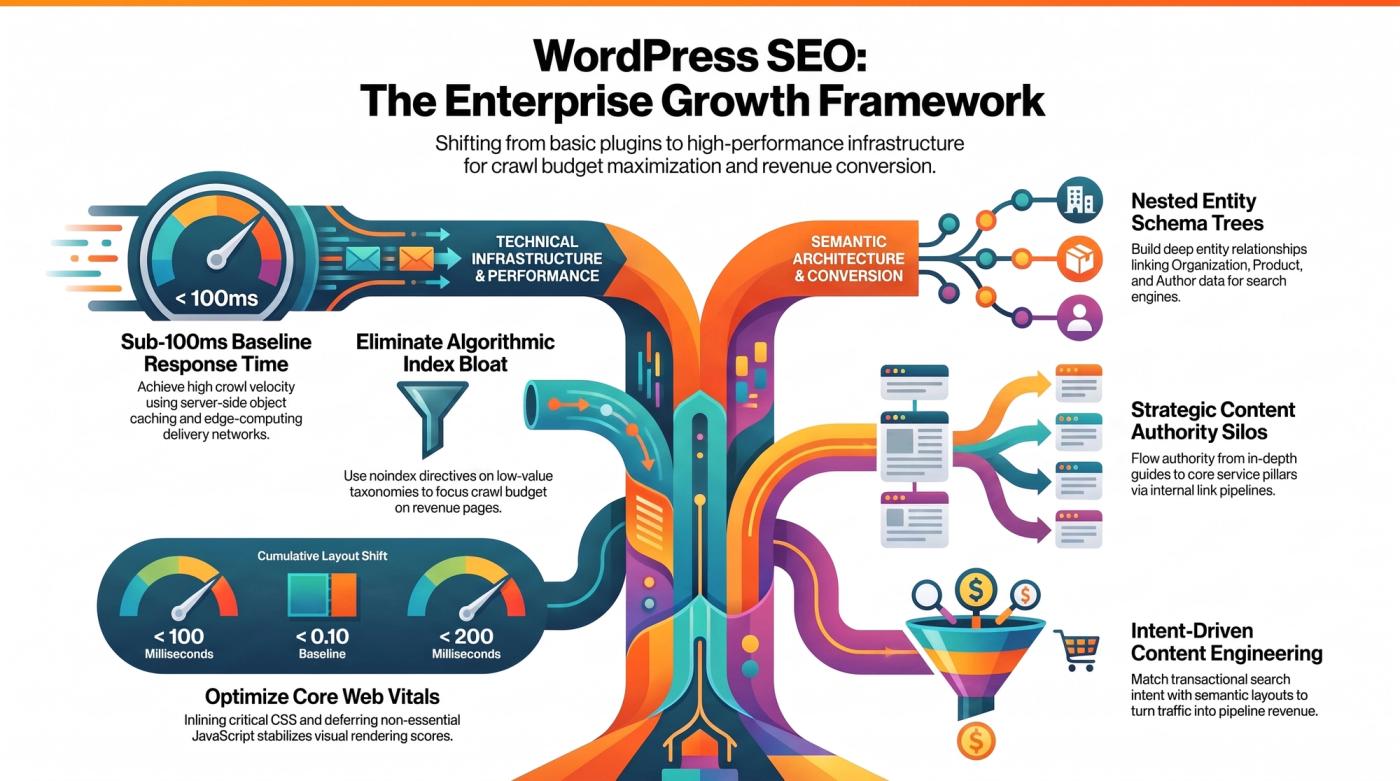
- Algorithmic Architecture: Legacy plugin setups create deep crawling inefficiencies that drain your crawl budget on low-value taxonomy pages.
- Infrastructure Optimization: Enterprise search performance scales on server-side optimization, headless rendering capacity, and object caching rather than basic front-end caching patches.
- Conversion Integration: Organic visibility fails without semantic landing page blueprints that convert automated search traffic into pipeline revenue.
Most mid-market marketing executives treat content management systems as passive design shells. They install a generic security plugin, activate a standard optimization suite, and assume their technical foundations are secure.
This passive approach is an expensive mistake. Standard out-of-the-box configurations inherently conflict with modern indexing models, leaving massive technical gaps that quietly bleed organic market share.
When your digital platform scales to thousands of pages, basic indexing errors magnify. Missing semantic markers, bloated script pipelines, and unoptimized database queries quickly stall growth. Silently, these technical inefficiencies turn high-intent organic traffic over to agile competitors.
True organic authority requires looking beyond basic keyword placement. It demands an enterprise-grade technical framework built around crawl efficiency, structural data architecture, and pristine asset delivery.
Why Technical Infrastructure and Crawl Efficiency Dictate Modern WordPress Search Visibility
AI Overview & Snippet Summary: Enterprise WordPress visibility relies on maximizing crawl budget through server-side infrastructure optimization and aggressive database hygiene. Eliminating code bloat, unindexing redundant taxonomies, and prioritizing edge-delivery assets ensure search engine spiders index high-intent revenue pages efficiently rather than wasting resources on low-value architectural scripts.
To dominate modern search engines, enterprise platforms must align with the technical standards defined by Google Search Central. Search engine spiders operate with strict resource limits known as a crawl budget. If your server takes hundreds of milliseconds just to respond to a basic request, or if your site architecture forces spiders to wade through thousands of auto-generated tag pages, your primary revenue content will remain unindexed.
The Enterprise Crawl Path Architecture
To maximize indexing efficiency, search engine spiders route directly through your edge infrastructure before accessing core pages.
- The Crawl Traffic Flow: Spiders query your edge network or CDN. If a clean, unbloated architecture is found, the system directs traffic smoothly to high-value indexed pages, such as your core category hubs, while blocking useless tag parameters.
- The Structural Risk Point: If stale caches or bloated script pipelines choke this edge interaction layer, the engine burns its allocated budget on technical errors instead of high-intent marketing assets.
The Architecture of High-Performance Enterprise Hosting
Enterprise hosting requires isolated server-side environments. Virtual private servers or managed container architectures prevent neighboring site traffic spikes from slowing your response times.
- Time to First Byte (TTFB) Optimization: Maintain a sub-100ms baseline by utilizing server-side object caching like Redis or Memcached alongside PHP-FPM execution layers to maximize dynamic server responses.
- Edge-Computing Delivery Networks: Deploy cloud routing networks that handle full-page caching, Brotli compression, and image optimization directly at the edge layer, completely bypassing origin server strain.
- Database Query Pruning: Clean structural databases weekly by automating the removal of old page revisions, expired transients, and spam comments that slow down your metadata lookups.
A common multi-thousand-dollar tracking mistake happens when teams configure edge caching networks without setting up correct cache-invalidation rules for dynamic parameters. This setup can accidentally serve personalized user sessions or internal tracking data to global search crawlers, resulting in major indexing corruption.
Eliminating Algorithmic Index Bloat and Duplicate Content
Standard content setups create duplicate URLs by default through categories, tags, and author archives.
- Taxonomy Indexing Control: Apply noindex directives to low-value tag archives while keeping only primary category hubs indexed to focus your search equity on high-performing URLs.
- Author Archive Management: Disable single-author archive views to prevent identical duplicates of your primary blog feed page from fragmenting authority.
- Global Canonical Enforcement: Force singular trailing-slash protocols and HTTPS routing within your root configuration files to prevent search engines from seeing split indexing signals.
A major technical platform risk lies in relying entirely on standard SEO plugins to handle canonical tags. When custom post types or headless templates are added, these plugins frequently drop canonical tags entirely or generate self-referential loops that confuse indexation engines.
Advanced Core Web Vitals and Code Asset Optimization
Modern rendering engines score sites based on visual stability and script execution speeds.
- Traditional Asset Loading Bottlenecks: Legacy page models process the HTML parse, pause to download heavy external CSS stylesheets, stop to execute bulk JavaScript, and finally execute a delayed first visual paint.
- Optimized Inline Asset Loading: Enterprise architectures combine the initial HTML parse with lightweight inline CSS to trigger an instant first visual paint, actively deferring secondary script processing until background execution space clears.
- Critical CSS Inlining: Extract structural layout styles and load them inline within the head tag, delaying non-essential styles to eliminate layout shifts during the paint phase.
- JavaScript Execution Delay: Defer non-critical tracking scripts, tag managers, and interactive elements until primary visual rendering completes to protect execution budgets.
- Media Layout Preservation: Explicitly declare aspect-ratio fields for all imagery, icons, and interface placements to completely stabilize asset loading profiles.
Mid-market firms frequently make the mistake of using automated design builders that inject excessive nested wrappers into the final code. This bloat lowers your DOM layout scores, creating performance issues that front-end optimization plugins cannot fix.
Building Conversions Through Strategic Content Engineering and Semantic Data Layouts
AI Overview & Snippet Summary: Scaling conversion revenue requires turning highly visible WordPress assets into structured customer acquisition paths. By combining clear semantic data layouts with targeted landing pages, entities can systematically match transactional search intent. This approach converts organic attention into measurable pipeline value across B2B and enterprise markets.
High rankings provide little value if your organic traffic bounces without interacting with your brand. True search visibility must connect directly with modern schema systems and clear user journeys. By structuring your site around semantic data frameworks, you ensure that search engines can easily parse your content while providing a seamless path toward conversions.
Implementing Comprehensive Semantic Schema Markups
Schema markup builds entity relationships that help retrieval engines extract clear contextual meaning from your content.
- The Enterprise Entity Tree Hierarchy: At the absolute root sits your Organization Schema, which explicitly verifies the real-world foundation of your brand.
- The Service and Review Sub-layers: Nested cleanly beneath that organization root is the Product or Service Schema, which branches out to hold individual review and star-rating blocks to validate customer trust markers directly within search nodes.
- The Author and Expertise Branch: Paralleling the product tree, an Author and Expert Schema maps individual content producers to verified external profile links, cementing structural authority markers across web discovery networks.
- Nested Product Data: Inject multi-layered schema trees that clearly connect active pricing, real-time availability, and verified client feedback directly to your core service pages to capture high-intent visual search real estate.
- Corporate Entity Verification: Deploy structured Organization markups linking official profiles, funding data, and leadership assets to build strong institutional trust signals across consumer platforms.
- Content Specific Formats: Apply specialized schema profiles like Article, FAQ, and Video Object markups to secure enhanced visual placements across search engine result pages.
Many brands make the mistake of hardcoding identical schema blocks across multiple pages. This practice creates conflicting metadata layers that can lead to search engine formatting penalties. Instead, use clean, dynamic generation tools tied to your primary data fields.
Maximizing Engagement with Strategic Content Layouts
High-performing organic content structures information around clear, transactional user intents.
- The Structural Authority Silo Pipeline: Authority links flow upward from specific, highly optimized landing pages directly into your primary service pillars.
- The Bottom-Up Link Distribution: Specialized child pages, such as an In-Depth Guide covering technical details, pass authority directly back to the top-level Core Service Pillar Page via optimized internal links.
- The Closed Optimization Loop: This bi-directional architecture ensures search engine robots distribute indexing equity efficiently through related categories while maintaining a clear directional funnel for human visitors.
- Intent-Driven Content Silos: Group related articles closely around core pillar pages using clear internal links to distribute authority throughout your service lines.
- Frictionless Conversion Steps: Position contextual call-outs and low-barrier offers naturally within educational articles rather than relying only on standard headers or footers.
- Clear Information Hierarchy: Organize copy using logical heading levels that let users quickly scan and find answers to their specific questions.
For a comprehensive approach to content organization, building an elite content marketing strategy means matching your deep internal link networks directly with target user journeys. This ensures every piece of educational content serves as a natural entry point to your primary solutions.
Scaling Visibility with Programmatic Templates
Programmatic templates allow enterprise platforms to efficiently scale geographic and categorical landing pages.
- Dynamic Data Fields: Utilize custom database fields to inject localized terms, regional pricing, and unique case studies into scalable page layouts automatically.
- Unique Text Variations: Incorporate conditional content rules to ensure every generated page remains unique, descriptive, and highly valuable to readers while avoiding template penalties.
- Clean Structural Permalinks: Enforce short, keyword-focused URL structures that clearly show page relationships without unnecessary folder levels.
When scaling up search footprints across multi-location home services or complex corporate spaces, using clean web design and development techniques is critical. Proper coding ensures your underlying page code scales efficiently without creating mass duplicate content flags.
Core Technical and Performance Benchmarks
To sustain competitive visibility across high-volume search systems, an enterprise web presence must be held to clear, measurable performance targets. Engineering teams should run automated monitoring tests weekly to track and preserve these architectural baselines.
To evaluate server infrastructure health, engineering teams must maintain strict delivery baselines. Cached static pages require a target under 100 milliseconds, while dynamically compiled server endpoints should deliver content in less than 500 milliseconds to preserve high crawl velocity.
Visual stability relies entirely on structural code discipline. Layout shifts must stay under a 0.10 baseline, which teams achieve by explicitly declaring static width and height fields for all background visuals, responsive media containers, and design blocks.
Real-time interface responsiveness is verified through standard paint lag inputs. Engineering teams target input delays under 200 milliseconds by deferring non-essential tracking trackers, external script managers, and tertiary analytical pixels until initial paint states finish executing.
Indexation health is managed through direct database alignment. Technical web operators ensure that total indexed search URLs map tightly against live customer acquisition environments, intentionally scrubbing broken architectural paths and temporary query fields from search records.
References
- Google Search Central Technical Standards: https://developers.google.com/search
- W3C Web Performance Standards: https://www.w3.org/standards/
Key Takeaways
To maximize platform performance, engineering teams must build server environments that look past basic user plugins. This requires deploying dedicated server-side caching environments and configuring routing directly at the edge layer to drop response latencies.
Crawl efficiency relies heavily on reducing systemic page noise. Growth architectures protect organic crawling limits by deploying systematic index commands that completely isolate thin search archives, repeating taxonomies, and unmonitored query links from algorithmic spiders.
Advanced machine lookup engines depend on explicit contextual linkages to surface relevant brand solutions. Implementing nested structural frameworks translates operational expertise into accessible entity graphs, securing premium visibility formats across answer platforms.
Capturing high-intent market pipelines demands that technical setups guide user action. Teams achieve this by connecting informational multi-page hubs directly to targeted transaction entry points through structured contextual pathways.
Connect With Our Growth Team
Building a high-performing organic presence requires deep alignment between your technical code and your market strategy. At Atlas Digital, we build custom, high-velocity digital growth frameworks designed to eliminate search friction, scale qualified leads, and capture measurable market share for mid-market and enterprise brands. If you are ready to move past basic plugins and transform your platform into an elite customer acquisition channel, reach out to our team today through our Contact and Consultation Page.